
What arbitrage betting really costs the New Zealand punter in 2026
 Available in US
Current as of 26 October 2026, checked against the Racing Industry Act 2020 and the Racing Industry Amendment Act 2025 as published by the New Zealand Government, with operator pages verified on the same day.
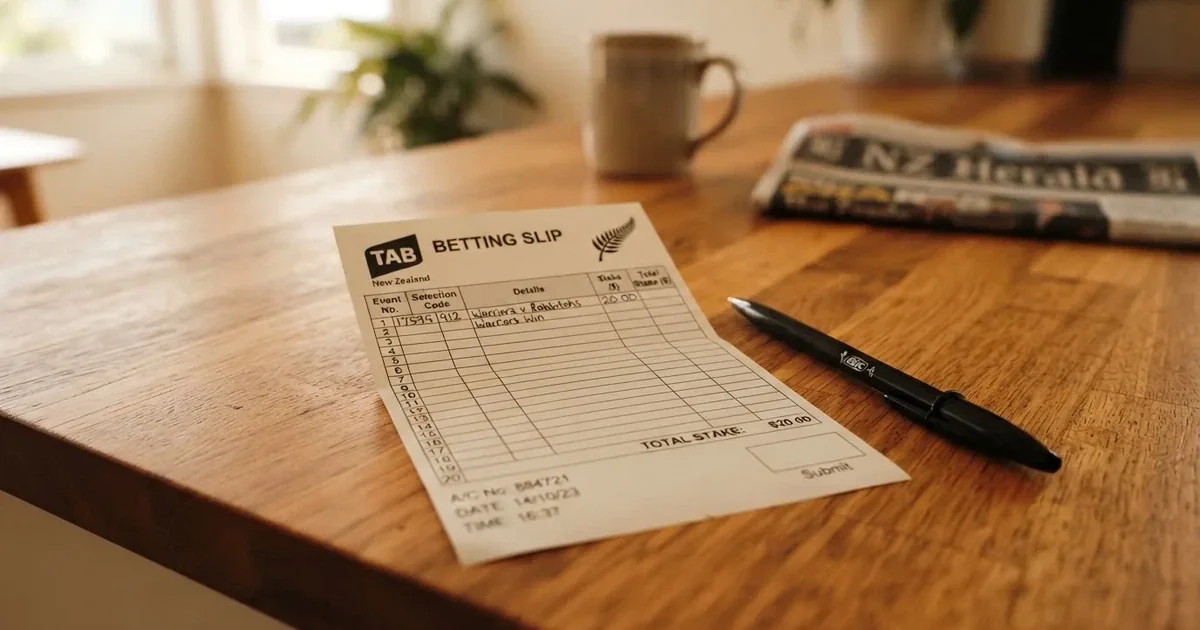
An arbitrage opportunity sounds like free money. Place every outcome, take the higher price at one firm and the lower at another, and pocket the gap whatever the result. The maths is real and the arithmetic is simple, but in New Zealand the picture is narrower than in markets where a dozen bookmakers chase the same fixture. Since 28 June 2025 only TAB NZ and its online sister brand Betcha may take online sports and racing bets from a person in New Zealand. A technique that needs several bookmakers with overlapping prices cannot be run inside the lawful market here. Outside it, the page that follows shows what an arbitrage actually returns, what the bookmaker’s margin does to the headline price, and what the practice costs in account closures and in stakes.
Table of Contents
- What a sure-bet calculation actually does
- The New Zealand legal frame around the bet
- The cost of arbitrage in account terms
- How the reviewed bookmakers line up
- What the maths of a two-way market actually returns
- What this kind of betting costs in player terms
- The pattern across the offshore firms
- Reading the page as one piece
- Frequently asked questions
What a sure-bet calculation actually does
An arbitrage opportunity exists when the odds cover all mutually exclusive outcomes of an event and their implied probabilities add up to less than 1.

That single sentence is the working definition. Convert each decimal price to its implied probability by dividing 1 by the odds, add the implied probabilities across every possible outcome, and read the total. Below 1.00 means a gap exists between the bookmakers’ combined view and a perfect 100% book. Above 1.00 and no arbitrage exists at those prices; the bookmaker side has already overpaid for the risk and the rest of the market will close the window within seconds.
The same arithmetic turns up in three different places on a serious bettor’s screen. A price-boost page says “we boosted this from 1.80 to 2.00”. An accumulator offer says “if one leg lets you down we refund your stake”. A matched-bet tutorial works through qualifying bets and free bets in the same language. Underneath each one sits the implied-probability sum, and underneath the implied probability sits the bookmaker’s margin — the cut the firm keeps of every dollar wagered on that market, before any individual punter wins or loses.
How the bookmaker’s margin sits inside the odds
For a two-way market priced at 1.90 on each side, the implied probabilities are 1 ÷ 1.90 = 0.5263 for the home win and 0.5263 for the away win, totalling 1.0526, or 105.26%. The excess over 100% is the margin: roughly 5.26% on this illustrative event. A fair book, where no margin is taken, prices both sides at 2.00 exactly and the implied probabilities sum to 1.00. The gap between 2.00 and 1.90 on each side is what the firm keeps of every dollar matched, on average, over many bets.

Stated as a band rather than a single figure: a symmetric 1.90 / 1.90 book carries about a 5% margin; a 1.85 / 1.95 book, still symmetric in spirit, carries a slightly higher margin; a 1.70 / 2.20 book on a heavy favourite carries a margin closer to 8%. Margins on outright and combination markets run higher than on match-result markets, and live markets widen further still once the price starts moving.
The margin is the single number a punter needs to read before any other. A 5% margin means 5 cents of every dollar wagered returns to the firm as gross profit before costs, before tax, before the marketing budget. A punter who bets $100 once and wins pays the bookmaker nothing on that single transaction but contributes to the 5% the firm expects to keep across thousands of similar bets. A punter who runs an arbitrage strategy moves money across both sides of the same market and still pays the margin, just on a different leg of the bet.
Why a 2% return still needs a five-figure bank
The 2012 study by Franck, Verbeek and Nuesch, widely cited in the academic literature on sports betting markets, found that 98% of arbitrage opportunities return less than 1.2% on the stake deployed. The term “arbitrage” describes an outcome with a positive expected value, not a windfall. A 1% return on a $1,000 stake is $10. A 1% return on a $20,000 stake is $200, before the cost of placing the bets, before any commission charged on one side of the trade, and before the tax treatment of the win.
This is the second feature of arbitrage that marketing material skips. The bets involve relatively large sums of money because the returns per dollar are small. The window is short — usually minutes between the price appearing on one firm and the rest of the market correcting it. The bettor needs accounts at several bookmakers, funds cleared in each, and the patience to act inside it. Anyone treating arbitrage as a side income for a $500 bank is treating it as a hobby, not a strategy.
How the return on a single bet is worked out
A winning bet returns the stake multiplied by the decimal odds. A $50 stake at 2.40 returns $120. The net profit, after the stake is set aside, is the stake multiplied by (odds minus 1): $50 × 1.40 = $70. For a combination bet whose legs are all winners, the odds of the legs multiply into a single price and the same formula applies to that combined price. The bookmaker’s margin is built into each leg of the combination, so the combined margin is wider than the margin on any single event.
That same multiplication is what closes an arbitrage. Bet $550 on outcome A at 1.90, bet $450 on outcome B at 2.30. Outcome A returns $550 × 1.90 = $1,045. Outcome B returns $450 × 2.30 = $1,035. Either way the return is around $1,040 on a $1,000 total stake, for a profit of about $40 before any commission or exchange fee. The implied probabilities sum to 1 ÷ 1.90 + 1 ÷ 2.30 = 0.5263 + 0.4348 = 0.9611, so a 3.89% gap exists between the two prices and a 4% return on the stake is what the maths allows for. That 4% is on the right side of zero, but it is not a salary.
The New Zealand legal frame around the bet
The monopoly that closed the offshore door
Since an amendment to the Racing Industry Act 2020 took effect on 28 June 2025, TAB NZ and its online sister brand Betcha are the only operators allowed to take online sports and racing bets in New Zealand, and the Department of Internal Affairs told unlicensed providers to withdraw with immediate effect.
Section 74AAA of the Racing Industry Act 2020, inserted by the Racing Industry Amendment Act 2025, sets the rule in plain terms: no person other than TAB NZ may offer racing betting, sports betting or other racing or sports betting to a person in New Zealand, regardless of where that person is resident or incorporated. The Department of Internal Affairs (DIA), the gambling regulator under the Gambling Act 2003, monitors compliance with the betting prohibition under section 92A of the same Act. There is no licence route for another operator to apply for and no register of bookmakers to be listed on, because there is only one lawful provider.
The framing matters more than the word “monopoly” suggests. The law does not geo-block offshore websites. It puts liability on the offshore operator, not on the player. Section 19(4) of the Gambling Act 2003, inserted in 2025, says an individual may not be convicted for placing a bet with an offshore betting operator in breach of section 74AAA. No published penalty for a player was found. Honest framing: TAB NZ and Betcha are the only lawful option, with New Zealand harm-minimisation tools, regulator oversight and a complaints framework. Offshore operators serving New Zealand are breaking New Zealand law at the firm level, not the punter level.
Why this collapses the arbitrage strategy in New Zealand
An arbitrage needs at least two — usually more — bookmakers with prices that disagree on the same event. In New Zealand the lawful market has one operator group with two brands, TAB and Betcha, and the two brands are run by the same trading team under the same partnership. TAB NZ’s partner Entain runs the TAB business under a 25-year agreement signed in 2023 that gives Entain a 50/50 share of gross profits, with at least $150 million a year going to TAB NZ for the first five years, and Entain pledged a one-off $100 million payment to the racing sector. A single trading desk does not produce the price disagreement arbitrage depends on, because the same model sets both sets of prices within seconds of each other.
The strategy requires an offshore bookmaker, and from 28 June 2025 the offshore bookmaker taking sports or racing bets from a person in New Zealand is breaking New Zealand law. The arbitrage still works on the page; it just no longer has a lawful place to run from inside New Zealand. The punters who run it from New Zealand today use offshore firms that serve them at the firm’s own legal exposure. The DIA warning that goes with that, which the page returns to below, is not a small thing.
What TAB NZ and Betcha may and may not offer
TAB NZ takes fixed-odds and tote (pool) bets. Its published betting rules cover Win, Place, Each Way, Quinella, Exacta, Trifecta, First Four, Double, Treble, Daily Double, Running Double, Quaddie and Big6, plus Multis and Same Game Multis where all the legs come from one event. Live betting is listed in the TAB NZ apps; any statutory restriction on in-play markets is not established, so the page does not state one. There is no lawful New Zealand betting exchange and spread betting is outside TAB NZ’s sports-betting definition: nothing is written about a New Zealand exchange here because the law does not establish one.
Greyhound racing is closing in stages from 1 August 2026, and from that date offshore operators may not take bets on greyhound races either. The closure removes one racing code from the calendar but does not affect the arbitrage question, since the price-disagreement mechanism does not depend on which code is running.
What this means for the offshore brands listed below
DIA warns that overseas operators may be in jurisdictions with minimal consumer safeguards, may not return unspent credits and may not pay out large wins. The point-of-consumption charge on offshore racing and sports bets ceased on 30 June 2026, so the offshore firm no longer pays that specific levy into the New Zealand system. A duty being payable does not make an offer lawful, and a duty no longer being payable does not make one lawful again. The page never writes that tax payment shows a bookmaker is legal in New Zealand.
The cost of arbitrage in account terms
Bookmaker-side response to a winning strategy
Bookmakers usually detect arbitrage betting quickly and view it unfavourably; maximum wager limits on such accounts often drop sharply, and in the past half of an arbitrage bet is cancelled or the account closed.
The bettor side of the trade and the bookmaker side of the trade see the same activity from opposite ends. A pattern of bets that always wins at the offered price is, to the bookmaker, a pattern of bets that always takes the firm-side expected value. The bookmaker’s response is not theoretical. The most common sequence is a stake reduction on the next bet, then a request for source-of-funds documentation, then a closure of the account with the balance returned. None of those steps is part of the marketing pitch that introduces the strategy to beginners.
For a New Zealand punter running the strategy across offshore firms, the second-order cost is sharper. The closure of one account leaves a gap in the network, and the gap has to be filled by opening another account, which usually requires a fresh email, a fresh address, and increasingly a fresh device fingerprint. The cost of running the strategy at scale is not just the margin eaten on each bet but the cost of staying ahead of the industry’s anti-arbitrage systems.
What gets cancelled and what gets paid
The historical pattern is that one leg of an arbitrage trade can be cancelled after the event, on the grounds that the price was posted in error. The other leg is left standing and the bettor has paid for one side of the trade without collecting the return from the other. The bookmaker keeps the cancelled stake and the bettor carries the loss. The bettor’s recourse is the bookmaker’s own dispute process, and for an offshore firm serving New Zealand from Curaçao or another offshore jurisdiction, that process sits outside New Zealand law.
The risk is symmetric across the listed offshore brands below. None of them are bound by New Zealand harm-minimisation rules, none of them are covered by the New Zealand complaints framework, and none of them offer the deposit limits, time-outs or self-exclusion tools that TAB NZ lists in its apps.
How the reviewed bookmakers line up
What each row in the table below covers
The comparison block sorts the ten brands into two groups. The first two are TAB NZ’s two online brands, the only operators that may lawfully take online sports and racing bets from a person in New Zealand. The remaining eight are listed for reference because New Zealand players meet them, each marked as not licensed in New Zealand. The table is not a ranking and not a recommendation. It puts the lawful providers first because the page is for a New Zealand reader, and the framework in the section above is the reason that order matters.
| Brand | New Zealand status | Operator’s own terms on arbitrage |
|---|---|---|
| TAB | One of two online brands of TAB NZ, the only provider lawfully offering racing and sports betting to people in New Zealand under section 74AAA of the Racing Industry Act 2020 | No published arbitrage-tolerance policy; account-level stake limits apply |
| Betcha | One of two online brands of TAB NZ, the only provider lawfully offering racing and sports betting to people in New Zealand under section 74AAA of the Racing Industry Act 2020 | No published arbitrage-tolerance policy; Toolbox runs daily odds boosts and insurance tools for bets that do not land |
| Glorion | Not licensed in New Zealand; only TAB NZ may offer racing and sports betting to people in New Zealand | Live chat and email support; customers over 18 only; no published arbitrage-tolerance policy |
| BillyBets | Not licensed in New Zealand; only TAB NZ may offer racing and sports betting to people in New Zealand | Three odds formats: Decimal, American and Fractional; sports cashback, reload bonuses and a five-level VIP programme |
| Roobet | Not licensed in New Zealand; Curaçao licence OGL/2024/687/0427 gives no right to take bets from people in New Zealand | Brand name of Raw Entertainment B.V., Curaçao registration 157205; no New Zealand complaints framework applies |
| 22Bet | Not licensed in New Zealand; Curaçao licence 8048/JAZ gives no right to take bets from people in New Zealand | Single, accumulator, system and chain bets; live betting with real-time odds and score updates |
| Rabona | Not licensed in New Zealand; Curaçao licence gives no right to take bets from people in New Zealand | Sixth Soft2Bet sportsbook, launched 23 December 2019; no New Zealand complaints framework applies |
| Golden Panda | Not licensed in New Zealand; no licence applies in New Zealand | Dedicated Sports Terms covering fixed-odds, Combo Bets, Bet Builder, live scoreboards and broadcasts, and stake and odds limits |
| BetNinja | Not licensed in New Zealand; Union of the Comoros licence gives no right to take bets from people in New Zealand | No New Zealand complaints framework applies |
| FunBet | Not licensed in New Zealand; no licence applies in New Zealand | Sportsbook covers football, ice hockey, American football, basketball, volleyball, tennis, rugby and baseball, with 24/7 live betting |
The lawful New Zealand providers and the offshore brands are not the same kind of offer. The two TAB NZ brands sit under the New Zealand harm-minimisation framework, the New Zealand complaints route and the Problem Gambling Levy paid by the operator. The eight offshore brands sit under their own jurisdictions’ frameworks, which give no New Zealand reader a path to a local complaints body and no access to the deposit limits, time-outs or self-exclusion tools that TAB NZ provides in its apps.
TAB and Betcha: the only lawful options in New Zealand
TAB and Betcha are the two online brands of TAB NZ, run by Entain under the 25-year partnership. They are not rivals. They share the same trading desk and the same odds, and they present the same markets under different skins.
TAB’s mobile app, listed as TAB – Racing & Sports Betting on the New Zealand App Store under the seller name New Zealand Racing Board, was first released on 8 September 2014 and lists deposit limits, time-outs and self-exclusion as its safer-gambling tools. The same self-exclusion applies across both brands: an exclusion set on TAB carries through to Betcha, and vice versa.
Betcha’s app, listed as betcha | Sports Betting on the New Zealand App Store, adds a daily Toolbox with odds boosts and insurance tools for bets that do not land, a Bet Social section where punters chat, follow tipsters and share bets or pools, and a Playbook with tips and match analysis. The two brands target different use cases but the same underlying odds.
A New Zealand punter comparing the two on price sees the same numbers. The differentiator is the format — the social feed, the daily Toolbox, the way the bet slip is laid out — rather than the market. The arbitrage question does not apply within this group. The two brands post the same prices within seconds of each other, so the implied-probability sum across them is exactly 1.00 plus the margin and no gap exists for the punter to take.
The offshore brands: not licensed in New Zealand, listed for reference
The eight brands below are listed because New Zealand readers meet them in offshore marketing, not because any of them may lawfully take bets from a person in New Zealand. Each one carries a licence from a jurisdiction other than New Zealand, and none of those licences gives a right to take bets from people in New Zealand. The page describes what each operator’s own terms say and leaves the lawful-versus-unlawful question to the section above.
Glorion runs a sportsbook and casino with live chat and email support, takes customers over 18, and does not name a licence that applies in New Zealand. A New Zealand reader has no local complaints route if a dispute arises and no access to the New Zealand harm-minimisation framework. The site accepts no New Zealand-specific safer-gambling tools.
BillyBets offers three odds formats — Decimal, American and Fractional — and runs sports cashback, reload bonuses and a coin shop where coins earned by depositing, betting, tournaments and challenges can be exchanged for free bets and free spins, with a five-level VIP programme on top. A New Zealand reader needs to read the bonus terms before claiming: a reload bonus whose wagering applies to the bonus plus the deposit is a heavier requirement than the same headline on a competitor that wavers only the bonus. The arithmetic on that is in the section on what a bonus actually costs.
Roobet is the trading name of Raw Entertainment B.V., registered in Curaçao under number 157205 at Korporaalweg 10, Curaçao, licensed under OGL/2024/687/0427. This licence does not authorise the operator to accept bets from New Zealand residents, and no New Zealand complaints framework applies to the brand. The site carries a casino and a sportsbook; the relevant question for a New Zealand reader is whether the firm pays out on a disputed bet, and that question is answered by the firm’s own terms rather than by any New Zealand regulator.
22Bet takes single, accumulator, system and chain bets, offers live betting with real-time odds and score updates, and operates under a Curaçao licence (8048/JAZ) held by TechSolutions Group N.V. The Curaçao licence does not authorise the operator to accept bets from New Zealand residents. A New Zealand reader looking at 22Bet’s bonus terms checks whether the wagering requirement applies to the bonus alone or to the bonus plus the deposit, because that single line is what determines how much real-money betting the bonus requires.
Rabona launched on 23 December 2019 as the sixth online sportsbook of the Soft2Bet group and operates under a Curaçao licence. This licence is not valid for New Zealand residents, and no New Zealand complaints framework applies. A New Zealand reader comparing Rabona to the other brands in the offshore cluster sees a similar offer structure with similar restrictions, and the same gap to a New Zealand complaints route.
Golden Panda publishes dedicated Sports Terms and Conditions that cover fixed-odds betting, Combo Bets, the Bet Builder feature, live scoreboards and broadcasts, and stake and odds limits. The brand names no licence that applies in New Zealand. A New Zealand reader needs to read the stake-and-odds-limits section before claiming any offer, since the cap on a winning bet is the single number that determines whether the bonus is worth the wagering it carries.
BetNinja states that it is licensed by the Union of the Comoros. The Comoros licence gives no right to take bets from people in New Zealand, and no New Zealand complaints framework applies. The site carries a casino and a sportsbook; the New Zealand reader has no local recourse on either.
FunBet’s sportsbook offers odds on football, ice hockey, American football, basketball, volleyball, tennis, rugby and baseball, with live betting and a bookmaker described as open 24/7. The brand names no licence that applies in New Zealand. The breadth of sports coverage does not change the licensing picture for a New Zealand reader.
What the comparison cannot show
The table leaves three pieces of information off the page by design. The first is a price column. Arbitrage opportunities are short-lived and event-specific, and the snapshot date ages within hours; the comparison is about the operator’s own terms rather than about a price on a specific match. The second is a margin column. Margins vary by event, by market and by snapshot date, and the margin on one match result is not the margin on another market at the same firm. The third is a payout-time column. Payout times are operator-level rather than event-level and are described in each operator’s own terms; the comparison does not assemble a single number across eight firms with eight different banking stacks.
What the maths of a two-way market actually returns
The arithmetic of an illustrative example
A symmetric two-way market priced at 1.90 on each side is the cleanest case to read. The implied probability on each side is 1 ÷ 1.90 = 0.5263, or 52.63%. Both sides together sum to 105.26%. The excess over 100% is the margin: 5.26% on this illustrative event.
Translate the margin into a payout share: 1 − 0.0526 = 0.9474, or 94.74% of every dollar wagered across both sides returns to punters as winnings, on average over many bets. The other 5.26% is what the firm keeps. A punt of $100 split $50/$50 returns, on average, $94.74 across the two outcomes, for an expected loss of $5.26 before costs.
Now widen the book to 1.85 / 1.95. The implied probabilities are 0.5405 and 0.5128, summing to 1.0533, or 105.33%. The margin is 5.33% and the payout share is 94.67%. The margin is wider, the payout share is narrower, and the difference shows up in every dollar wagered on the market.
A 1.70 / 2.20 book on a heavy favourite gives implied probabilities of 0.5882 and 0.4545, summing to 1.0427. The margin is 4.27%, lower than the symmetric case, but the payout on the favourite is smaller in absolute terms. Margins on outright and combination markets run higher than on match-result markets, often 8% to 12% on a long-shot accumulator, and live markets widen further still.
The real price: read the margin, not the headline
The headline number a bookmaker publishes is the decimal odds on a single outcome. The number a serious reader examines is the margin across all outcomes of the market. The margin is the one figure the firm cannot quote without revealing its own cost of running the book, and it is the one figure a comparison between firms can be made on. Two firms quoting the same odds on the same event are running different margins if their books on the other outcomes differ, and the difference compounds over many bets.
The arbitrage punter reads the same number for a different reason. A book whose combined implied probabilities sum to less than 1.00 is a book with a gap, and the gap is what the strategy takes. A book whose combined implied probabilities sum to 1.05 is a book that pays the holder 95 cents in the dollar across all bets, and an arbitrage that takes 1% of the stake as profit is offset by the 5% the firm keeps on the rest of the book.
Where this leaves the New Zealand reader
The arithmetic is universal. The market structure is not. In markets where several bookmakers compete for the same fixture, arbitrage opportunities arise when one firm is slow to move its price, when another has a different view on the probability, or when a price-boost page has mispriced a leg. In New Zealand, where only TAB NZ and Betcha may take online bets and both post the same prices, those opportunities do not arise inside the lawful frame. They arise, if at all, between a TAB NZ price and an offshore price — and the offshore leg carries the legal exposure on the operator side and the cancellation risk on the bettor side, as the section on bookmaker response above covers.
What this kind of betting costs in player terms
The responsible-gambling frame around the strategy
TAB NZ provides safer gambling tools in its app, namely deposit limits, time-outs and self-exclusion, and lists the free New Zealand gambling helpline 0800 654 655 and the text line 8006.
The page is not a tip sheet and the page does not tell a reader to run an arbitrage strategy. It describes what the strategy is, what it returns on average, and what it costs in account terms, and the responsible-gambling frame applies to the strategy the same way it applies to any other form of betting.
The age for TAB NZ betting is 18; betting under 18 is an offence under section 89 of the Racing Industry Act 2020. Land-based casinos are 20 — the two ages are not merged on this page. TAB NZ accounts need a verified New Zealand address and ID. The age check, the ID check and the address check are what links the account to the New Zealand harm-minimisation framework, and that link is what an offshore account does not carry.
TAB NZ lists deposit limits, time-outs and self-exclusion in its apps. An exclusion set on TAB applies across its brands, so an exclusion on TAB carries through to Betcha. There is no single national online-betting exclusion register; the register the online casino law will introduce is for online casinos only, and the betting exclusion is at the operator level. Help lines are the free Gambling Helpline on 0800 654 655 or by text on 8006, and Safer Gambling Aotearoa for the wider framework.
The wider frame around the offshore choice
DIA warns that overseas operators may be in jurisdictions with minimal consumer safeguards, may not return unspent credits and may not pay out large wins. The warning is not a line on a regulator’s website that can be ignored. It is the position the regulator takes in writing, and it is the position a New Zealand reader is choosing to step outside when placing a bet with an offshore firm.
The New Zealand harm-minimisation framework does not reach the offshore firm. The deposit limit a punter sets at TAB NZ does not carry across to an offshore account; the self-exclusion a punter triggers at TAB NZ does not bar them from opening an offshore account. The New Zealand complaints route does not apply to a dispute with an offshore firm. The Offshore choice costs the New Zealand reader the framework, not just the lawful status of the bet.
What an offer looks like when the wagering lands
A bonus or free-bet offer that the marketing material describes in a single sentence usually carries a wagering requirement that the marketing material skips. The wagering is the requirement to bet the bonus amount (or, on a deposit-gated package, the bonus plus the deposit) a stated number of times at or above a stated minimum price before the bonus balance becomes withdrawable. A free bet whose stake is not paid back with a win is a smaller offer than the same headline in cash. A “risk-free” bet refunded as a free bet is not a refund in money; it is a refund in another wagering requirement.
The expected cost of clearing the offer is the required turnover multiplied by the margin of the market the wagering is run on. A bonus with a 5x wagering requirement on the bonus alone, run on a market with a 5% margin, costs the bettor 25% of the bonus in expected loss before the bonus is withdrawable. The headline “5x bonus” reads as a story of a generous free ride; the arithmetic reads as a story of a 25% toll on the bonus balance. The cost is what the bonus actually costs.
The New Zealand reader needs to read the wagering requirement and the minimum price before claiming any offer, at TAB NZ, at Betcha, or at any of the offshore brands above. The wagering requirement is the single number that determines whether the offer is worth taking.
The pattern across the offshore firms
What each operator’s own terms say about the bets on offer
The eight offshore brands above vary on the menu of bets they offer, on the promos they run, and on the licence they carry. They do not vary on the lawful status for a New Zealand reader, which is the same for all eight.
Ivibet lists a sportsbook menu that includes Sports Betting, Live Betting, Racing, Forecasts, Boosted Odds and Copy Bets alongside its casino and live casino sections. Tonybet offers Casino, Live Casino, Prematch, Live Betting, Promotions, a VIP Club, Bettors Tournament, Forecasts, Boosted Odds and a Copy Bet feature. LegendPlay lists sports promotions named First Deposit Bonus, Weekly Reload Bonus, Sport Jackpot, Virtual Sports Excitement and Acca Boost. The three brands illustrate the shape of the offshore sportsbook offer: a wide menu of bet types, a long list of promotions, and a thin connection to the New Zealand reader’s local framework.
The New Zealand reader looking at an offshore brand examines the menu and the promo list and looks at the wagering requirement, the minimum price, the cap on winnings from a free bet, and the deadline for clearing the offer. Those four numbers determine what the offer is worth. The brand name and the menu are the marketing layer; the four numbers are the substance.
Where the price-disagreement mechanism sits, if it sits anywhere
A price-disagreement between two bookmakers needs two bookmakers. The lawful New Zealand market has two brands, but those two brands are the same operator group with the same trading desk. The offshore firms do not post prices that disagree with TAB NZ by enough to clear the margin on both sides of the trade, and the price-disagreement that exists is between the offshore firm and the rest of the offshore market, not between the offshore firm and TAB NZ.
The arbitrage punter inside New Zealand faces a closed frame. The lawful New Zealand market does not produce the price disagreement. The offshore market produces the price disagreement but at the cost of the legal exposure on the operator side and the cancellation risk on the bettor side. The combination produces a small return per dollar and a high cost per dollar to set up, and the page returns to that point in the section on what an arbitrage actually costs in account terms above.
Reading the page as one piece
Where the cost sits, and where the cost does not
The cost of an arbitrage strategy is not in the arithmetic, which is free. It is not in the price-aggregation step, which is the same on every platform. It is in the account infrastructure — the several accounts at several firms, each one funded, each one with a verified identity, each one running on a separate device fingerprint — and in the lifetime of those accounts under the bookmaker’s anti-arbitrage systems. The expected profit per dollar is small. The expected cost of staying in the strategy is large in time and in account churn.
The New Zealand frame makes the cost sharper. The lawful market does not support the strategy. The offshore market supports the strategy but at the cost of the lawful status of the bet and the New Zealand harm-minimisation framework around it. The expected profit per dollar is the same number a punter in a multi-firm market sees. The expected cost per dollar is higher in New Zealand than it is in a market where the strategy is legal at the operator level.
Where the maths and the law agree, and where they do not
The maths says the strategy returns a small percentage on a large stake. The law says the strategy cannot be run inside the lawful New Zealand market and the offshore leg carries legal exposure on the operator side. The arithmetic and the legal frame agree on the smallness of the return and disagree on the cost of running the strategy. The New Zealand reader looking at the page is not looking at a tip sheet; the page describes what an arbitrage is and what it costs, and the comparison finishes
The closing position is plain. The bookmaker’s margin sits inside every price a New Zealand punter sees, and the margin is wider on the markets where the marketing layer locks the spread. The two TAB NZ brands are the only lawful options for online sports and racing bets in New Zealand, and the two brands are not rivals for the arbitrage question because they post the same prices within seconds. The offshore brands carry their own licences, their own menus, their own bonuses and their own restrictions, and none of those carries a New Zealand harm-minimisation framework or a New Zealand complaints route. The choice is between a closed lawful frame and an open offshore frame, and the page leaves the choice to the reader rather than making it for them.
Frequently asked questions
Does sports arbitrage betting work?
It works on the page and at a small percentage of the stake deployed. The 2012 study by Franck, Verbeek and Nuesch found that 98% of arbitrage opportunities return less than 1.2%, so a working arbitrage needs a five-figure bank to produce a meaningful return. The bookmaker’s response — stake limits, account reviews and closures — is the second cost the marketing material skips.
How to arbitrage bet?
Place one bet on each mutually exclusive outcome of an event at different bookmakers, sized so the return covers the stake plus a small profit on whichever outcome lands. The implied probabilities across the outcomes must sum to less than 1.00. In New Zealand, only TAB NZ and Betcha may lawfully take online bets, so the strategy needs at least one offshore firm and runs at that firm’s legal exposure.
How to do arbitrage betting?
The mechanics are: convert each decimal price to an implied probability, sum the probabilities across all outcomes, and size the stake on each side so the return is the same whichever outcome lands. A 1% return on a $10,000 stake is $100. The cost is the account infrastructure and the lifetime of those accounts under the bookmaker’s anti-arbitrage systems.
Which bookmaker may lawfully take sports and racing bets in New Zealand?
TAB NZ and its online sister brand Betcha, under section 74AAA of the Racing Industry Act 2020, in force since 28 June 2025. The Department of Internal Affairs told unlicensed providers serving New Zealand to withdraw with immediate effect. There is no licence route for another bookmaker and no register of bookmakers because there is only one lawful provider.
How is the return on a bet worked out from the stake and the odds?
The return is the stake multiplied by the decimal odds, so a $50 stake at 2.40 returns $120. The net profit, after the stake is set aside, is the stake multiplied by (odds minus 1): $50 at 2.40 returns a $70 profit. For a combination bet, the odds of the legs multiply into a single price and the same formula applies to that combined price.
What is the bookmaker’s margin and how can it be seen in the odds?
The margin is the cut the firm keeps of every dollar wagered on a market, on average over many bets. Convert each decimal price to its implied probability (1 ÷ odds), sum the probabilities across all outcomes, and subtract 1.00. The excess is the margin. A symmetric 1.90 / 1.90 book carries about a 5% margin; a 1.85 / 1.95 book carries a slightly higher margin; outright and combination markets carry wider margins, often 8% to 12%.
Written by the editors at Nzgolfodds.